
Hiring a maid/foreign domestic worker for the first time is a significant step for many households in Singapore. While engaging a maid agency in Singapore can help manage the administrative requirements, first-time employers may still face challenges if they are unfamiliar with the process.
6 Common Mistakes First-Time Employers Make and How to Avoid Them
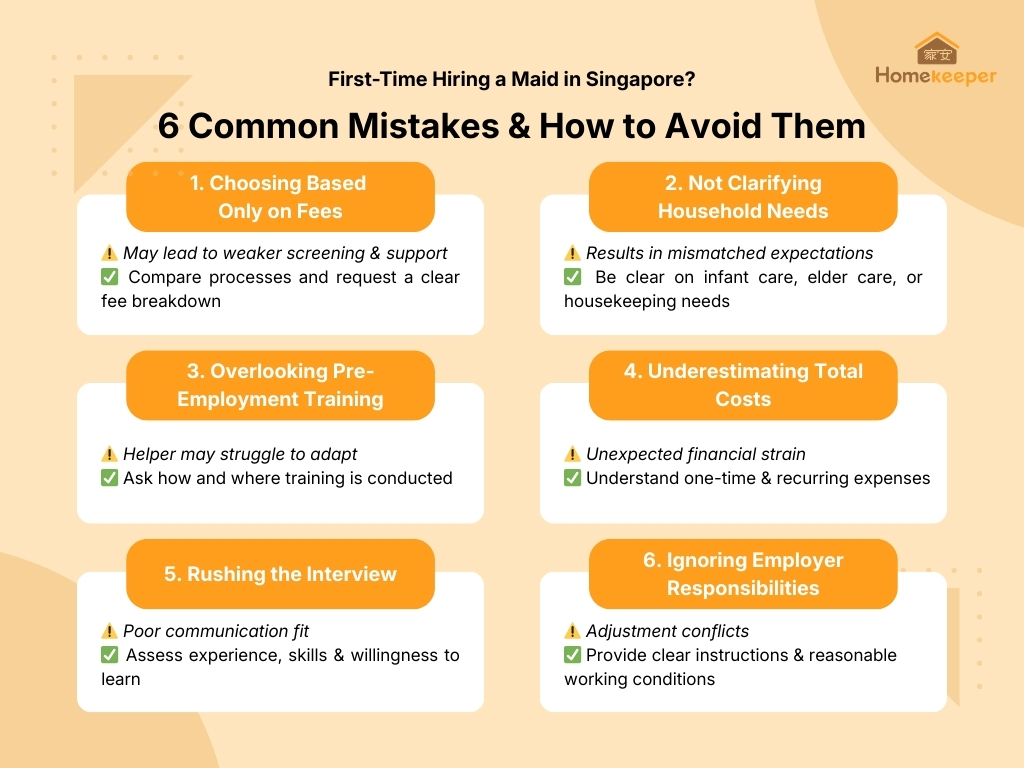
Understanding common mistakes early allows employers to make more informed decisions, set realistic expectations, and approach the hiring journey with greater clarity and confidence.
Mistake 1: Choosing a Maid Agency Based Solely on Fees
Cost is often one of the first considerations for first-time employers. However, selecting a maid agency based purely on lower agency fees may lead to issues later on.
Agency fees typically reflect the scope of services provided, including screening and matching, coordination of pre-employment training, handling employment paperwork, and post-placement support. Employers are encouraged to request a clear breakdown of fees so they understand what is included and avoid misunderstandings.
Instead of focusing only on price, it is more helpful to evaluate whether the agency provides structured processes, clear communication, and reliable support throughout the hiring process.
Mistake 2: Not Clarifying Household Needs Clearly
Every household has different requirements. Some families require support primarily for infant care, others for elder care, while some need assistance with general housekeeping or a combination of responsibilities.
First-time employers sometimes assume that a foreign domestic worker will automatically understand expectations. Being clear about daily routines, language preferences, and specific care responsibilities helps the maid agency shortlist more suitable candidates and reduces misunderstandings during the adjustment period.
Mistake 3: Overlooking the Importance of Pre-Employment Training
While paperwork and compliance are necessary, training often determines how smoothly a foreign domestic worker adapts after deployment.
Not every maid agency in Singapore places the same emphasis on structured pre-employment training. Training that covers infant care, elderly care, housekeeping skills, language development, and familiarisation with Singapore household practices can help prepare domestic workers before they begin work.
For example, at Homekeeper, foreign domestic workers undergo structured training both in their home country and in Singapore before deployment. We work with experienced training centres and have also developed a Homekeeper training programme focused on key care skills such as infant care and elderly care, so helpers are better prepared before they start work.
Mistake 4: Underestimating the Total Cost of Hiring
Many first-time employers focus only on agency fees and overlook other cost components involved in hiring a foreign domestic worker.
Engaging a maid agency typically involves both one-time and recurring costs. In addition to agency fees, a significant portion of the one-time cost can come from overseas application-related expenses, depending on the source country and arrangement.
Employers should also be aware that the overall cost of hiring a foreign domestic worker may include:
- Work permit and related government fees
- Mandatory medical examinations
- Maid insurance coverage
- Settling-In Programme requirements
- Monthly salary and levy obligations
Understanding both one-time and recurring expenses helps employers plan their budget more realistically. It is advisable to request a clear cost breakdown before proceeding.
Mistake 5: Rushing the Interview and Selection Process
When there is an urgent need at home, it may be tempting to confirm a helper quickly. However, rushing the interview process can result in mismatched expectations.
During interviews, employers should assess:
- Relevant work experience
- Communication ability
- Willingness to learn and adapt
- Comfort level with specific responsibilities
A good maid agency like Homekeeper, will assist with interview arrangements, help employers prepare relevant questions, and provide constructive feedback when multiple candidates are shortlisted, supporting a more informed decision.
Mistake 6: Not Understanding Employer Responsibilities
Hiring a foreign domestic worker involves responsibilities beyond recruitment. Employers are required to comply with Ministry of Manpower (MOM) regulations and provide reasonable working conditions.
Clear instructions, respectful communication, and realistic expectations contribute significantly to a stable working relationship. First-time employers who understand their role from the outset often experience a smoother adjustment period.
How First-Time Employers Can Approach the Process More Confidently
First-time hiring does not need to be complicated. Working with a structured maid agency in Singapore that provides clear guidance, transparent communication, and proper coordination of training and paperwork helps reduce uncertainty.
At Homekeeper, employers are supported through each stage of the hiring process, from selection to deployment and beyond, with practical guidance based on household needs. This helps first-time employers navigate the process more confidently without having to manage every detail on their own.
Conclusion
Most issues faced by first-time employers do not happen suddenly. They usually come from unclear expectations, incomplete cost understanding, or rushing key decisions such as interviews and selection.
By taking time to ask the right questions, understanding what is included in maid agency services, and setting clear routines from the start, employers can reduce misunderstandings and support a smoother adjustment period for both the household and the foreign domestic worker.
Looking for Support as a First-Time Employer?

If you are hiring a foreign domestic worker for the first time, Homekeeper is here to help. First-time employers often face uncertainty around screening, interviews, training standards, cost breakdowns, and employment paperwork, and having structured guidance can make the process more manageable.
With experience in sourcing, training, and supporting foreign domestic workers, Homekeeper assists employers through each stage of the hiring process, from selection to deployment and beyond. This includes helpers for infant care, elder care, general housekeeping, or a combination of household needs. Our team is available to provide clear information and practical guidance based on your household requirements. Reach out to us for further assistance or to find out more about the hiring process.
Frequently Asked Questions (FAQs)
1. Is it necessary to engage a maid agency in Singapore?
Not always. In Singapore, it is not mandatory to use a maid agency, but many employers do so for help with paperwork, compliance, and guidance. However, if you are hiring a Filipino helper from the Philippines, a maid agency is required due to Philippine overseas employment regulations.
2. What should I assess during the interview?
Employers should assess relevant work experience, communication ability, willingness to learn, and comfort level with specific household responsibilities. Clear and practical questions help set realistic expectations and reduce misunderstandings later.
3. What kind of pre-employment training should a helper undergo?
Structured training may include infant care, elderly care, housekeeping skills, language development, and familiarisation with Singapore household practices. Proper training helps foreign domestic workers adjust more smoothly after deployment.
4. What are the main costs involved in hiring a foreign domestic worker?
Costs may include agency fees, overseas application-related expenses (which can form a significant portion of one-time costs), work permit and government charges, medical examinations, insurance, and ongoing monthly salary and levy obligations. Employers are encouraged to request a clear breakdown before proceeding.
5. What if the helper is not suitable after starting work?
Many maid agencies offer replacement or transfer support under specific terms and conditions. First-time employers should clarify coverage periods and eligibility criteria in advance to manage expectations.
6. What are my responsibilities as an employer?
Employers must comply with Ministry of Manpower regulations, provide reasonable working conditions, and communicate expectations clearly. A respectful and structured environment helps support a smoother adjustment period.
About the Author
Linda Seh has over 20 years of experience in the Employment industry. She takes the time to thoroughly interview each family and helper to understand their requirements, personalities, and preferences. Her intuition and insight has helped her make placements that result in lasting, harmonious working relationships. Linda now leverages this expertise and experience to simplify your search and ensure you find the ideal and qualified helper to become a valued member of your family.