
Bringing a helper into your home to care for your child is a big decision, and a deeply personal one. You want someone who can lighten your load, keep your little one safe, and become a trusted part of the household. At the same time, many parents quietly worry about where the line sits. What exactly is a childcare helper responsible for? And just as importantly, what falls outside her role, whether by law or by good sense?
It is a fair question, and one we hear often. Knowing the answer upfront helps you set clear expectations, stay on the right side of the rules, and build a working relationship that lasts. Here is an honest, practical look at what a childcare helper in Singapore can and cannot do.
What is a Childcare Maid?
A childcare domestic helper is hired primarily to look after children in your home. She holds a valid Work Permit issued by the Ministry of Manpower (MOM), which ties her to a single employer and one registered residential address. Her job scope covers household and caregiving duties carried out within that home.
In other words, this is not a separate licence or qualification. She is a domestic helper whose duties lean towards caring for your children, often supported by childcare training before she is deployed. The clearer you are about her role from day one, the smoother the placement tends to be.
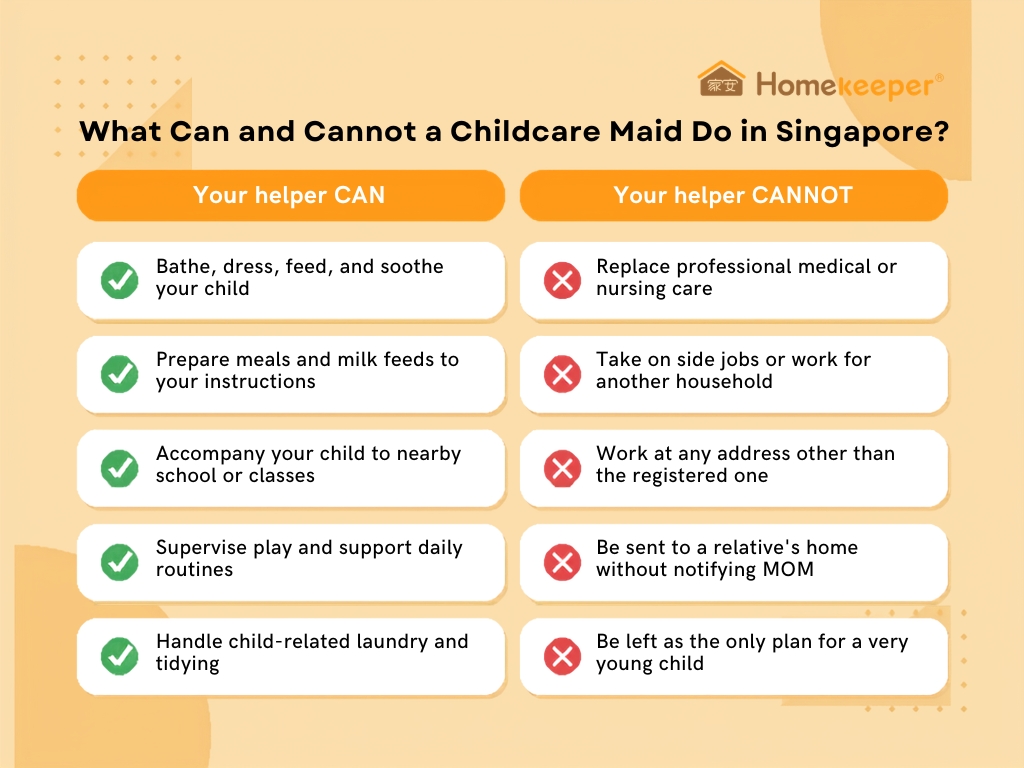
The Quick Answer: What Can and Cannot a Childcare Maid Do in Singapore?
What a childcare maid CAN do?
A well-trained helper can take on a wide range of day-to-day tasks that make family life far more manageable. These are the responsibilities most families rely on.
1. Daily care and routines. Your helper can manage the everyday rhythm of caring for your child: bathing, dressing, grooming, supporting toilet training, managing naps and bedtime, and soothing an unsettled or crying child. For infants, a helper trained in infant care can also handle feeding, sterilising bottles, swaddling, and diaper care.
2. Meals and feeding. Preparing meals is a core part of the role. She can plan simple menus, cook for the children, prepare milk feeds to your instructions, and make sure your child eats well. Many helpers can also cater to dietary preferences or restrictions once you have briefed them clearly.
3. School runs and enrichment. With your permission, a helper can take your child to and from nearby school or enrichment classes, and help with the daily back-and-forth that working parents struggle to cover. She can support light homework, reading, and revision, though she is there to assist, not to act as a private tutor.
4. Play, supervision, and early development. Beyond the practical tasks, a good helper plays an active part in your child’s day. She can supervise play, bring children to the playground, engage them in age-appropriate activities, and keep a watchful eye to prevent accidents at home. Helpers who genuinely enjoy being around children often form a warm, natural bond with them.
5. Child-related housekeeping. Caring for a child creates plenty of mess. She can wash and fold the children’s clothes, tidy their rooms and play areas, clean feeding equipment, and maintain general hygiene at home. These tasks sit comfortably within the scope of domestic work.
What a childcare maid CANNOT (or should not) do?
Just as important as knowing what your helper can do is understanding where the boundaries lie. Some limits are set by law. Others are simply matters of safety and common sense.
1. She cannot work outside your registered address. Under MOM rules, a helper can only carry out her duties at the residential address on her Work Permit. She cannot be sent to work in a shop, office, business, or another household.
2. The relative’s house rule, in full. This is the one most families get wrong. If you need your helper to care for your child or parent at a relative’s home, MOM allows it, but only if you do the following first:
- Notify MOM through the official e-service before the arrangement begins.
- Obtain your helper’s written agreement to care for your child or parent there.
- Make sure she does not carry the full load of housework in both households.
- If she needs to stay overnight, ensure her accommodation there meets MOM’s requirements.
Skipping these steps counts as illegal deployment, even with the best intentions, and the employer (not the helper) is held responsible. Penalties can include fines and a ban on hiring in future. When in doubt, check with your agency or MOM before changing where she works.
3. She cannot take on outside or commercial work. Your helper is employed for domestic and caregiving duties only. No side jobs, no helping run a family business, no working for anyone other than her registered employer. This keeps you compliant and protects her from exploitation.
4. She is not a medical professional. A trained helper can manage everyday care and minor matters such as cleaning a small scrape or giving prescribed medicine according to your instructions. What she cannot do is replace professional medical care. She is not a nurse, doctor, or therapist, and should never be expected to diagnose conditions, decide on treatment, or handle a medical emergency alone. For anything beyond routine care, your child should see a qualified professional.
5. She should not be your only plan for a young child. A helper supports your parenting; she does not replace it. As the parent, you remain ultimately responsible for your child’s wellbeing and safety. Major decisions on health, schooling, and discipline stay with you, and there should always be a clear plan for supervision, especially with very young children.
Final Thoughts
When families start thinking about hiring help with the children, the most useful question is what kind of daily support is actually needed at home.
A childcare maid in Singapore can take on many of the routines that fill a parent’s day, including bathing, dressing, feeding, preparing meals, managing naps and bedtime, supervising play, accompanying children to nearby school or classes, and handling child-related housekeeping. Just as important is knowing the limits: she works only at your registered address, she is not a replacement for professional medical care, and she supports your parenting rather than taking over the decisions that should stay with you.
Once you are clear on both the duties and the boundaries, it becomes much easier to decide whether this type of support is the right next step for your household.
Need Help Finding the Right Childcare Maid?

Choosing a helper to care for your child is not only about filling a role. It is about finding someone your child feels safe with, and someone you can trust to handle the everyday with patience and attention.
At Homekeeper, childcare helpers are trained in practical daily care skills such as feeding, bathing, hygiene, soothing, toileting and safety and precautions. This gives families greater assurance that their little one is receiving warm, structured care at home.
Reach out to us if you would like to learn more about childcare support at home.
Frequently asked questions
- Can my helper take my child out alone?
Yes, with your permission. School runs, trips to the playground, and short errands with your child are all within her role. You remain responsible for your child’s safety, so brief her clearly on routes, timings, and what to do in an emergency.
- Can my helper give my child medicine?
Only medicine you have approved, following the exact dosage and instructions you provide. She should never decide on medication herself. For anything beyond routine, see a doctor.
- Can my helper sleep in the same room as my child?
She can share a room with your child if night-time care is needed. MOM does require that your helper is given adequate space and privacy, so where possible, a proper sleeping arrangement should still be planned rather than treated as permanent.
- Is a childcare maid the same as a trained nanny?
No. A nanny is a professional childcare specialist. A childcare maid is a domestic helper, often with infant-care or childcare training, whose duties also include household work. Both can care for your child well, but the role and scope are different.
About the Author
Linda Seh has over 20 years of experience in the Employment industry. She takes the time to thoroughly interview each family and helper to understand their requirements, personalities, and preferences. Her intuition and insight has helped her make placements that result in lasting, harmonious working relationships. Linda now leverages this expertise and experience to simplify your search and ensure you find the ideal and qualified helper to become a valued member of your family.