
Hiring a domestic helper in Singapore is a significant financial commitment. Besides the monthly salary, employers need to budget for recruitment, insurance, the foreign worker levy and other employment expenses.
When searching for a cheap maid in Singapore, it can be tempting to compare helpers and agencies mainly by price. Yet the lowest salary or cheapest package may not offer the best match for your household.
A lower salary does not necessarily mean that a helper is less capable. Similarly, paying more does not guarantee better performance or a successful placement. The important consideration is whether the helper’s skills and expectations match your family’s needs, and whether the costs and services have been clearly explained.
Here is what employers should consider before making a decision based on price alone.
Understanding the Cost of Hiring a Maid in Singapore
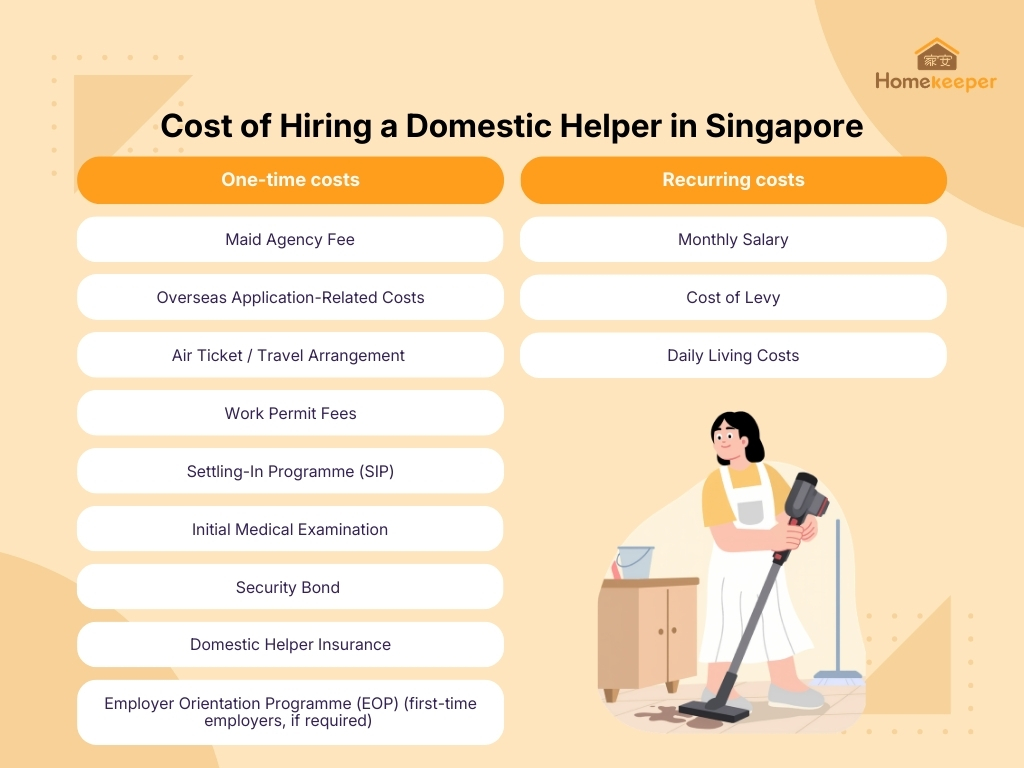
As explained in our Complete Guide to Hiring a Domestic Helper in Singapore, the cost of hiring a maid in Singapore includes both one-time expenses and ongoing employment costs.
One-Time Hiring Expenses
Depending on the helper’s circumstances and the hiring arrangement, these may include:
- Agency service fees: Charges for recruitment, candidate matching, documentation and other services specified in the quotation.
- Work Permit and overseas processing: Application and issuance fees, source-country documentation and other applicable arrangements.
- Travel and medical examination: Airfare where applicable and the required pre-employment medical examination for a newly arrived helper.
- Training and orientation: The Settling-in Programme (SIP) for first-time migrant domestic workers, as well as the Employer Orientation Programme (EOP) for first-time employers where required.
- Insurance and security bond: Required medical and personal accident insurance, plus a S$5,000 security bond generally required for a non-Malaysian helper.
The S$5,000 security bond is arranged as a banker’s or insurer’s guarantee. It should not be mistaken for a standard S$5,000 cash fee paid to the agency.
Ongoing Employment Expenses
Employers must also provide for the helper’s agreed monthly salary, daily living needs such as food and accommodation, and the monthly maid levy.
According to the Ministry of Manpower (MOM), the levy is generally S$300 per month for the first helper and S$450 for subsequent helpers. Eligible households with caregiving needs may qualify for the S$60 concessionary rate.
There are also periodic expenses, including medical examinations, insurance renewals and medical treatment when needed. The total therefore depends on more than an agency’s advertised starting price.
1. The Lowest Salary May Not Match Your Household’s Main Needs
Monthly salary is often one of the first figures employers compare. However, it does not tell you whether a helper has the skills required for your family.
For example, a household that mainly needs cooking and general housekeeping may be comfortable hiring a first-time helper and providing guidance. A family that needs assistance caring for an infant or an elderly parent with limited mobility may place greater importance on relevant caregiving experience.
This does not mean an experienced maid is always a better choice or that a fresh maid cannot handle important responsibilities. What matters is the individual candidate’s abilities and the level of support available at home.
If you are weighing these options, read more about Fresh Maid vs Experienced Maid in Singapore: Which One Should You Choose?
2. A Lower Maid Agency Fee May Cover Different Services
Two agencies may offer different quotations because their packages do not include the same services.
One package may include candidate shortlisting, interview arrangements and employment paperwork. Another may charge separately for selected administrative work, training or post-deployment assistance. A lower fee can still offer good value, but employers need to know exactly what they are comparing.
Before paying, ask for an itemised quotation showing the agency service fee, charges payable to third parties and any additional services that are optional. Confirm whether the quotation includes the arrangements your family requires, rather than assuming everything is covered by the advertised price.
It is also useful to understand who will handle the Work Permit paperwork and other documentation. These tasks can take time if the employer needs to manage them separately.
3. Placement Loans Can Make Upfront Quotations Look Different

Some hiring arrangements include a placement loan that the employer advances on the helper’s behalf. This is different from an agency service fee because the amount may be recovered under the agreed repayment arrangement.
For example, one quotation may require a larger initial payment because it includes a placement loan, while another may have a lower upfront amount. Looking only at the initial payment does not show which option has the lower final cost.
If a placement loan applies, clarify the amount, the repayment schedule and how payments will be recorded. The arrangement should be explained to both parties and reflected in the relevant agreements. Employers should also check the terms that apply if the employment ends before the loan is fully repaid.
MOM advises employers to refer to their agency contract for the circumstances under which an outstanding placement loan may be refunded if employment ends early.
4. Training Needs Can Affect How Practical a Hiring Choice Is
A helper’s salary is not the only factor to consider, especially when your household requires specific skills such as infant care, elderly care, or general housekeeping.
A fresh maid may need more time to become familiar with her responsibilities, while an experienced helper may already have relevant skills. However, proper pre-employment training can help prepare both fresh and experienced helpers for their duties.
At Homekeeper, domestic helpers undergo structured training in their home country and Singapore before deployment. Through partnerships with experienced training centres and Homekeeper’s own training programme, helpers receive preparation in areas such as infant care, elderly care, general housekeeping, and communication skills.
Before making a hiring decision, consider the pre-employment training each candidate has received and whether her skills match your household’s needs. A helper with relevant training may be a more suitable choice than one selected based on a lower salary alone.
5. Deployment Timing May Matter More Than a Small Saving
A cheaper option may not be the most practical if your family needs help within a specific timeframe.
For example, a household whose current helper is leaving soon may need to arrange temporary childcare or elderly care if the selected candidate is still overseas. These arrangements can add inconvenience and expense while the family waits.
Deployment timelines vary depending on the helper’s location, documentation, approvals and other requirements. A helper who is already in Singapore may be available sooner, but the actual start date still depends on the circumstances and required approvals.
Ask the agency when each shortlisted helper could realistically begin work. If your household can wait, a longer timeline may be acceptable. If there is an urgent caregiving need, availability deserves greater weight in the decision.
6. Support After Deployment Can Be Valuable

An agency’s role does not always end once a helper arrives at the employer’s home.
During the first few months, employers and helpers may need assistance with communication difficulties, unfamiliar responsibilities or questions about employment arrangements. Depending on the agency’s services, counselling or additional training may be available.
This does not mean that every misunderstanding requires agency intervention. Many issues can be resolved through clear instructions and reasonable expectations. However, knowing where to seek assistance can be useful if a difficulty continues.
When reviewing agency packages, find out what post-deployment support is included, how to request it and whether additional charges apply. These details can help you judge the value of the service beyond the initial recruitment process.
7. Replacement and Refund Terms Can Affect the Overall Cost
Even after a careful selection process, there may be situations where employment ends earlier than expected.
Under MOM’s employment agency service-fee refund rules, an agency must refund at least 50% of qualifying service fees when a migrant domestic worker’s employment ends within the first six months and the relevant conditions are met. The rules contain exclusions, including certain circumstances involving replacement helpers or agencies engaged only for administrative work.
This does not mean that half of every payment made during hiring is automatically refundable. The statutory definition of agency service fees excludes specified expenses such as Work Permit charges, certain travel and medical costs, and the helper’s placement loan.
Before signing the agency agreement, review the replacement arrangements, any additional processing charges and the notification steps required if employment ends early. These conditions may matter more than a small difference in the initial quoted fee.
How to Compare Two Maid Agency Packages
When two options seem similar, use the following questions to make a fair comparison:
1. What is the full upfront payment?
Separate agency service fees from third-party expenses and any placement loan.
2. What will the household pay each month?
Consider the agreed salary, applicable levy and living expenses, not just the advertised salary.
3. Can the candidate manage the essential duties?
Consider relevant experience, the availability of training and how much supervision your family can provide.
4. When can the helper start?
Find out whether the timeline suits your household’s actual needs.
5. What happens after placement?
Review the support available and the written replacement and refund arrangements.
Conclusion
Affordability is an important consideration when hiring a domestic helper in Singapore. However, the cheapest helper or agency package is not necessarily the most suitable choice for every family.
A lower-salaried helper may be a good match when her skills meet the household’s needs and the family can provide appropriate guidance. An agency with a lower service fee may also offer good value when the charges and included services are transparent.
Rather than choosing solely based on price, compare the full hiring arrangement, the helper’s suitability and the support available. This can help your family make a decision that is manageable financially and practical in the longer term.
Looking for a Suitable Domestic Helper Within Your Budget in Singapore?

Finding a suitable domestic helper involves balancing household needs, preferred experience and employment costs. Having clear information about the candidates and the hiring arrangement can make the decision easier.
Established in 1998, Homekeeper has helped more than 80,000 families find suitable domestic helpers in Singapore. With over 300 candidate profiles, comprehensive background checks, and training support through local and overseas training centres, we help employers consider candidates according to their household requirements.
From candidate shortlisting and interviews to Work Permit applications, employment documentation and deployment arrangements, Homekeeper can assist throughout the hiring process. We also provide counselling and additional training after deployment when needed.
Whether you are looking for a fresh maid or an experienced helper, contact Homekeeper to discuss your family’s needs and explore suitable options within your budget.
Frequently Asked Questions
- Does a Lower Maid Salary Mean the Helper Is Less Experienced?
Not always. Salary expectations can reflect several factors, including previous employment and the candidate’s circumstances. Review each helper’s actual experience and skills instead of judging suitability by salary alone.
- Is the S$5,000 Security Bond an Agency Fee?
No. The security bond generally required for non-Malaysian helpers is a banker’s or insurer’s guarantee. It is different from an agency service fee, and employers should check the cost of arranging it with their provider.
- Can I Get a Lower Monthly Maid Levy?
Eligible households may qualify for a concessionary levy of S$60 per month, including certain families with a young child, an elderly person or a person with disability. Check MOM’s current eligibility requirements before assuming the concession applies.
- Can I Get a Refund if My Helper Leaves Within Six Months?
A refund of at least 50% of qualifying agency service fees may apply when employment ends within the first six months and MOM’s conditions are met. Other expenses and placement loans have different rules, so review the agency agreement carefully.
- Is It Always Cheaper to Hire a Maid Directly?
Not necessarily. Direct hiring may avoid some agency service charges, but employers still need to handle the required documentation, insurance, travel and employment obligations. Compare the full costs and the time involved before choosing an arrangement.