
Hiring a domestic helper can make it easier to manage childcare, eldercare, and daily household responsibilities. However, your helper’s salary is not the only regular expense you need to plan for. Employers must also pay a monthly maid levy to Singapore’s Ministry of Manpower (MOM).
The maid levy is S$300 per month for the first helper and S$450 per month for each subsequent helper. Households with eligible caregiving needs may qualify for the lower rate of S$60 per month. The levy is generally paid through GIRO or PayNow QR by the 17th of the following month.
This guide explains how much you need to pay, when payments begin, how to qualify for the concessionary rate and what happens if your payment is late.
Maid Levy in Singapore at a Glance
| Common question | Quick answer |
| What is maid levy? | A monthly fee paid by employers of migrant domestic workers |
| How much is the levy for the first helper? | S$300 per month |
| How much is the levy for subsequent helpers? | S$450 per month |
| What is the concessionary rate? | S$60 per month |
| When is payment due? | By the 17th of the following month |
| How can employers pay? | GIRO or PayNow QR |
| Who may qualify for the S$60 rate? | Households with an eligible child below 16 years old, elderly person or person with disabilities. |
| Can levy charges be waived? | Yes, in specific situations such as qualifying overseas leave or hospitalisation leave |
What Is Maid Levy in Singapore?
The maid levy is a compulsory monthly fee that employers pay for each migrant domestic worker they employ.
Its official name is the migrant domestic worker levy. It may also be referred to as FDW levy, foreign domestic worker levy, helper levy or domestic helper levy.
Employers do not need to make CPF contributions for migrant domestic workers. However, they must pay the monthly levy directly to MOM.
The levy is separate from your helper’s salary. It is an employer’s expense and should not be deducted from the helper’s pay.
How Much Is Maid Levy in Singapore in 2026?
The maid levy rate depends on the number of helpers you employ and whether your household qualifies for a concession.
| Levy type | Monthly rate | Daily rate |
| Normal rate for first helper | S$300 | S$9.87 |
| Normal rate for subsequent helpers | S$450 | S$14.80 |
| Concessionary rate | S$60 | S$1.98 |
The monthly rate applies when your helper is employed for a full calendar month. MOM uses the daily rate when your helper is employed for only part of the month.
How Much Does Maid Levy Cost Per Year?
At the normal first helper rate, the annual levy is S$3,600.
A household paying the S$60 concessionary rate spends S$720 per year. This means an eligible household can save S$2,880 annually compared with the normal first helper rate.
| Levy type | Monthly cost | Annual cost |
| First helper | S$300 | S$3,600 |
| Subsequent helper | S$450 | S$5,400 |
| Concessionary rate | S$60 | S$720 |
A Simple Cost Example
Suppose a couple employs one helper and does not have an eligible person living in the household. Their monthly maid levy will normally be S$300.
If the couple later has a Singapore citizen child, the household may qualify for the S$60 rate from the child’s date of birth. Their monthly levy would fall by S$240, provided the qualifying requirements are met.
When Does Maid Levy Start and End?
For a helper working in Singapore for the first time, the levy begins on the fifth day of her arrival, including the arrival date.
For a helper who has worked in Singapore before, the levy begins on the day after she arrives.
Levy charges end when the helper’s Work permit expires or is cancelled.
The levy does not automatically stop just because your helper has stopped working or travelled overseas. Her Work permit status and eligibility for a waiver will determine the final amount payable.
How to Pay Maid Levy in Singapore
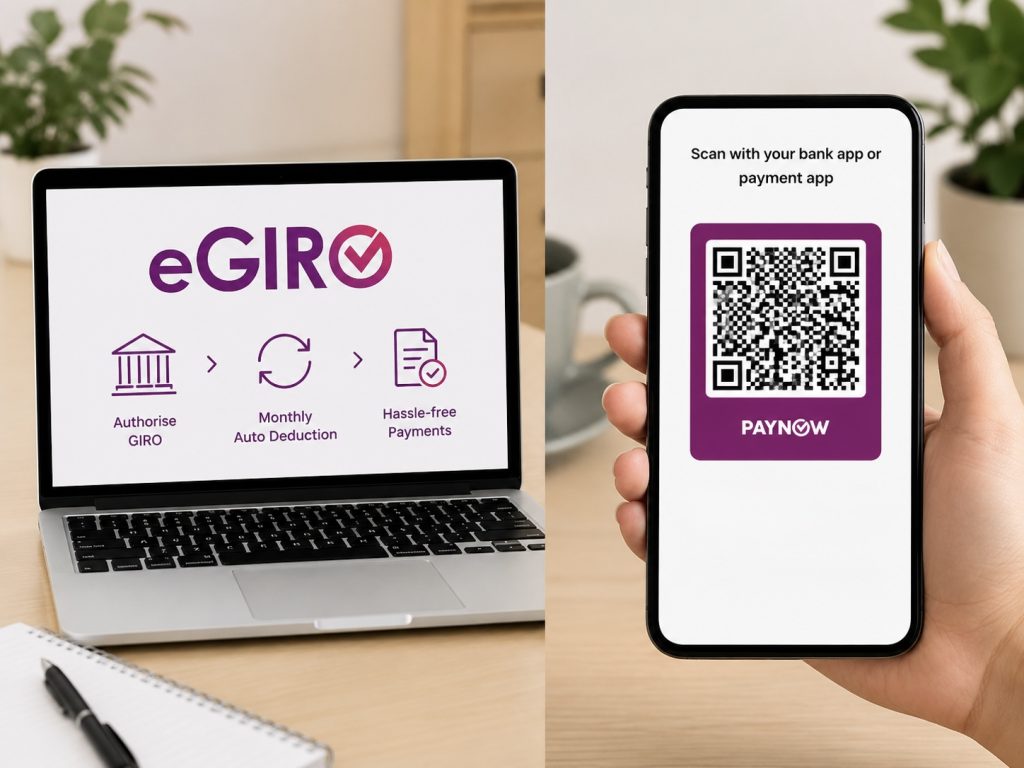
Employers must pay the levy for each month by the 17th of the following month.
When the 17th falls on a Saturday, Sunday or public holiday, payment is due on the next working day. The exact payment deadline will appear on your levy bill.
MOM currently provides two main payment methods:
How to Pay Maid Levy Through GIRO
GIRO allows your maid levy to be deducted automatically each month.
If your bank supports eGIRO:
- Log in to MOM’s levy payment service.
- Select eGIRO under your account summary or GIRO section.
- Complete the application through your bank’s online banking portal.
Check that your payment limit is high enough to cover the levy bill. You may also leave the expiry date blank to avoid having to reapply later.
For corporate accounts, the authorised approver must approve the request within 48 hours.
If your bank does not support eGIRO, download the GIRO form for MDW employers and mail the completed original form to Levy GIRO Team.
While waiting for approval, you can pay through PayNow QR.
How to Pay Maid Levy Through PayNow QR
PayNow QR can be used when you do not have an active GIRO arrangement, your GIRO application is still being processed, or a deduction has failed.
To make payment:
- Log in to MOM’s Check and Pay Foreign Worker Levy service using Singpass.
- Generate the PayNow QR code for the outstanding amount.
- Open your mobile banking application.
- Scan the QR code or import the saved QR image.
- Confirm that the registered payee is the Ministry of Manpower.
- Check the amount before completing the transfer.
A successful payment produces an immediate confirmation message. The payment record should appear in your account within one working day.
The generated QR code expires at the end of the following day. You will need to generate a new one if it expires before payment is completed.
Who Is Eligible for the S$60 Concessionary Maid Levy?
A household may qualify for the S$60 concessionary rate when an eligible person lives with the employer.
The main qualifying groups are:
| Eligible person | Main qualifying condition |
| Young child | Singapore citizen below 16 years old |
| Elderly person | Singapore citizen aged 67 or above |
| Elderly permanent resident | Aged 67 or above, subject to citizenship and family relationship requirements |
| Person with disabilities | Certified as requiring help with at least one activity of daily living |
The concession applies to one helper for each eligible person. It is capped at two helpers per household.
This means a household must have two eligible people to receive the concessionary rate for two helpers.
- Households With a Young Child
The household may qualify when a Singapore citizen child below 16 years old lives with the employer.
When the employer is the child’s parent, the concession normally starts automatically from the child’s date of birth.
When the employer is not the parent, the child must be added as a household member through the FDW eService.
- Households With an Elderly Person
A Singapore citizen aged 67 or above may qualify the household for the lower rate.
When the eligible person is the employer or the employer’s spouse, the concession normally starts automatically when that person turns 67.
For another household member, the employer and eligible person must have the same address on their NRICs. The eligible person must also be added as a household member through the FDW eService.
Permanent residents aged 67 or above may qualify under specific Singapore citizenship and family relationship conditions.
- Households With a Person With Disabilities
A person with disabilities may qualify when a Singapore registered doctor certifies that the person requires help with at least one activity of daily living.
These activities include washing, feeding, dressing, walking, moving between a bed and chair, and using the toilet.
The eligible person must meet MOM’s citizenship or permanent residency requirements, live at the same registered address, and be added as a household member. An application to the Agency for Integrated Care is also required.
How to Apply for a Maid Levy Concession
The concession may be granted automatically when government records show that your household meets the qualifying conditions.
However, you may still need to:
- Ensure that the eligible person lives at your registered address.
- Update both NRIC addresses when required.
- Add the eligible person as a household member through the FDW eService.
- Apply through the Agency for Integrated Care when the concession is based on a person with disabilities.
Once the requirements are completed, the reduced rate and any backdated adjustment should appear within the next two levy bills.
If the concession is not granted, MOM provides separate online forms for employers to check their eligibility for a child, elderly person or person with disabilities. MOM states that the outcome and next steps are generally sent by email within two working days.
Maid Levy Concession VS Maid Levy Waiver
A levy concession and levy waiver are not the same.
| Maid levy concession | Maid levy waiver |
| Reduces the regular levy to S$60 | Removes levy charges for an approved period |
| Based on an eligible person living in the household | Based on temporary circumstances affecting the helper |
| Continues while eligibility remains | Applies only to specific dates |
| May be granted automatically | Requires an application |
For example, a household with a Singapore citizen child below 16 may receive the concessionary rate each month.
In comparison, an employer whose helper goes on qualifying overseas leave may apply to waive the levy only for the approved leave period.
When Can Employers Apply for a Maid Levy Waiver?
Employers may apply for a waiver in the following situations:
| Situation | Main requirement |
| Overseas leave | At least seven consecutive days |
| Hospitalisation leave | Issued by a Singapore registered doctor from a local medical institution |
| Police or embassy custody | Supporting letter stating the custody period |
| Death of helper | Copy of the death certificate |
Waivers for overseas leave and hospitalisation leave are capped at 60 calendar days per calendar year.
- Levy Waiver for Overseas Leave
Levy charges continue while your helper is overseas. You can apply for a waiver after she returns to Singapore.
No supporting documents are normally needed because MOM can verify her travel records.
If your helper does not return, cancel her Work permit if it is still valid before applying for the eligible waiver period.
- Levy Waiver for Hospitalisation Leave
Hospitalisation leave must be issued by a Singapore registered doctor from a local medical institution.
The medical certificate should contain the helper’s name, FIN, hospitalisation period, medical institution, doctor’s name and medical certificate number.
How to Apply for a Maid Levy Waiver
You can apply from the first day of the month after receiving the relevant levy bill. The application must be submitted within one year of the bill.
Log in with Singpass to apply for a maid levy waiver through MOM’s Check and Pay Foreign Worker Levy service.
MOM generally processes applications within 12 working days. When the waiver is approved, the amount will be credited to your levy account and used to offset your next levy bill. If you have no upcoming bills, you may apply for the remaining credit to be refunded to your bank account.
What Happens If Maid Levy Is Paid Late?
Employers who do not pay the full levy by the deadline may face:
- A late payment penalty
- Revocation of the helper’s Work permit after two consecutive missed payments
- Restrictions on applying for new Work permits
- Legal action to recover the unpaid amount
The penalty is calculated based on the unpaid levy and the number of days it remains overdue. It is not simply a fixed S$50 charge.
When a GIRO deduction fails, check the reason and make payment through PayNow QR as soon as possible. Waiting for the next deduction may cause additional charges to accumulate.
How to Check Maid Levy Bills and Payment Records
Employers can use MOM’s Check and Pay Foreign Worker Levy service to manage their levy account.
After logging in with Singpass, you can:
- View and download current and past levy bills.
- Check the levy breakdown for your helper.
- Review payment and adjustment details.
- Apply for GIRO.
- Pay through PayNow QR.
- Apply for waivers and refunds.
- Check the status of an application.
The latest bill is normally available on the third working day of each month.
Employers can view levy bills dating from January 2017, searching up to 15 months at a time. Payment records for the previous 15 months are also available.
Conclusion
Understanding the maid levy helps you plan the true monthly cost of employing a domestic helper and avoid unexpected penalties.
The normal monthly rate is S$300 for the first helper and S$450 for subsequent helpers. Households with eligible caregiving needs may qualify for the S$60 concessionary rate.
For most employers, setting up GIRO is the simplest way to keep payments on schedule. You should still review your levy bills whenever your household circumstances change, your helper travels overseas or her Work permit status is updated.
Homekeeper Maid Agency can guide employers through maid levy matters and the administrative requirements involved in hiring a domestic helper in Singapore.
Need Help Managing Your Maid Employment Paperwork?

Paying the maid levy is only one part of employing a domestic helper. Employers must also manage work permit applications, renewals, cancellations, and other required documents.
At Homekeeper, our team assists employers with maid employment paperwork, including Work permit matters, passport renewals, embassy endorsements, home leave documents and repatriation arrangements.
Reach out to Homekeeper if you need support managing the administrative process of hiring or employing a domestic helper in Singapore.
Frequently Asked Questions
- Can maid levy be deducted from my helper’s salary?
No. The maid levy is an employer’s responsibility. It is separate from your helper’s salary and should not be deducted from her pay.
- Can someone else pay the maid levy for me?
An existing sponsor or authorised family member may pay through PayNow QR on behalf of an employer. The family member must first be authorised to access MOM’s levy service.
- Why did my maid levy rate change?
Your levy rate may change when you are no longer eligible for a concession or when the number of helpers in your household changes. The adjusted rate takes effect immediately.
- Do I still pay maid levy when my helper is overseas?
Yes, levy charges continue initially. You may apply for a waiver after your helper returns when her overseas leave lasted at least seven consecutive days.
- Can I get a refund if I overpaid the levy?
Yes, provided your MOM account shows an excess credit marked as “CR”. You can apply for a refund through the levy service within one year from the date the credit was added to your account.
- Can two helpers receive the concessionary rate?
Yes, but the household must have two eligible people. One concession is granted for each eligible person, with a maximum of two helpers per household.
- Does the maid levy stop when my helper leaves Singapore?
Not automatically. The levy ends when her Work permit expires or is cancelled. A separate waiver may apply for qualifying overseas leave.
About the Author
Linda Seh has over 20 years of experience in the Employment industry. She takes the time to thoroughly interview each family and helper to understand their requirements, personalities, and preferences. Her intuition and insight has helped her make placements that result in lasting, harmonious working relationships. Linda now leverages this expertise and experience to simplify your search and ensure you find the ideal and qualified helper to become a valued member of your family.